|
Service Item
|
Service Type
|
Deliverables
|
|
iPSC Gene Editing Services
|
Coding gene knockout (frameshift mutation)
|
a vial of biallelic gene knockout cell line + final project report
|
|
Point mutation (<20bp fragment)
|
a vial of heterozygous point mutation cell line + final project report
|
|
Gene knock-in (20bp-2kb fragment)
|
a vial of heterozygous knock-in cell line + final project report
|
Service Features:
Featured Gene Editing Services: Specialized lncRNA knockout services and iPSC-specific gene editing services are available.
No Exogenous Gene Integration: Delivered via RNP electroporation, avoiding random insertion mutations caused by lentiviral vectors and off-target effects caused by CRISPR/Cas9 integration.
High Efficiency and Short Turnaround Time: Gene knockout projects can be completed in as little as 2 months, with 100% correctly modified monoclonal cell lines delivered.
Professional Services: One-to-one communication with dedicated technical support, a detailed feasibility analysis report prior to project kickoff, and full professional technical support throughout the project cycle.
Follow-up Supporting Technical Services: RNA-seq services are available to support mechanistic research such as the identification of relevant signaling pathways.
Case Introduction:
Case│iPSC CYFIP2 c.259C>T Point Mutation | Partner: Hunan Provincial Maternal and Child Health Care Hospital
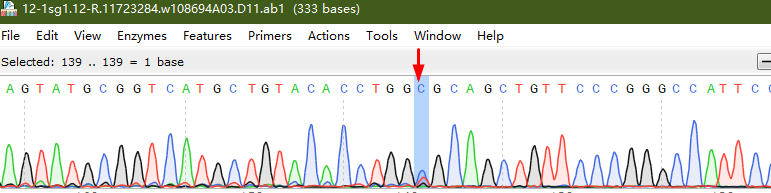
Result Verification: The sequencing results of the mixed cells are shown below (sequenced with reverse primer, the base selected in blue is the c.259C>T target mutation site). It can be seen from the figure that after electroporation of sgCYFIP2, a red peak T appears at the c.259C>T position, indicating that a certain amount of "c.259C>T" was mutated back to "T" in the mixed cells. Subsequently, single clone picking and identification were performed, and the mutant cell line was obtained in a single round of screening.







 Home
Home
 Building 28, No. 18, Lane 99, Chun Guang Road, Minhang District, Shanghai, China
 +86-400-8228-027
 market@somaxbio.com